Journey Planner
Introduction
Journey Planner is used for planning commuter’s journey from one place to another.
It aims to enhance the commuting experience by offering detailed, real-time information and optimizing travel routes using various public transportation modes like buses, metro or both.
Why Build a Journey Planner Service?
Modern urban regions offer multiple public transport modes (buses, metro, first/last mile options), making trip planning complex. A journey planner enhances the commuting experience by:
- Empowering Users: Provides optimal, real-time route options across all available modes.
- Personalization: Considers user preferences for time, cost, accessibility, and convenience.
- Reliability: Utilizes open standards like GTFS and live vehicle tracking for accurate results.
- Scalability: Designed to serve large metropolitan areas with high user concurrency.
- Ecosystem Integration: Enables apps, web platforms, kiosks, and physical displays to offer consistent trip planning services.
Core Functional Capabilities for Multimodal Trip Planning
The following table outlines the key functional features supported across different transport modes for seamless trip planning.
| Feature | Bus | Metro | Multi-modal |
|---|---|---|---|
| Real-time direct trips | ✔ | ✔ | ✔ |
| Real-time with transfer | ✔ | ✖ | ✔ |
| Scheduled trips | ✔ | ✔ | ✔ |
| ETAs shown | ✔ | ✔ | ✔ |
| Multiple suggestions | ✔ | ✔ | ✔ |
Additional Enhancements:
- Walkability & Accessibility: Ranks stops by proximity (default: 300m) and step-free access availability.
- Amenities Metadata: Provides details on gates, lifts, and parking at key stations (where available).
- Personalization: Offers filters based on time, cost, and route complexity in terms of number of interchanges for tailored planning.
System Overview
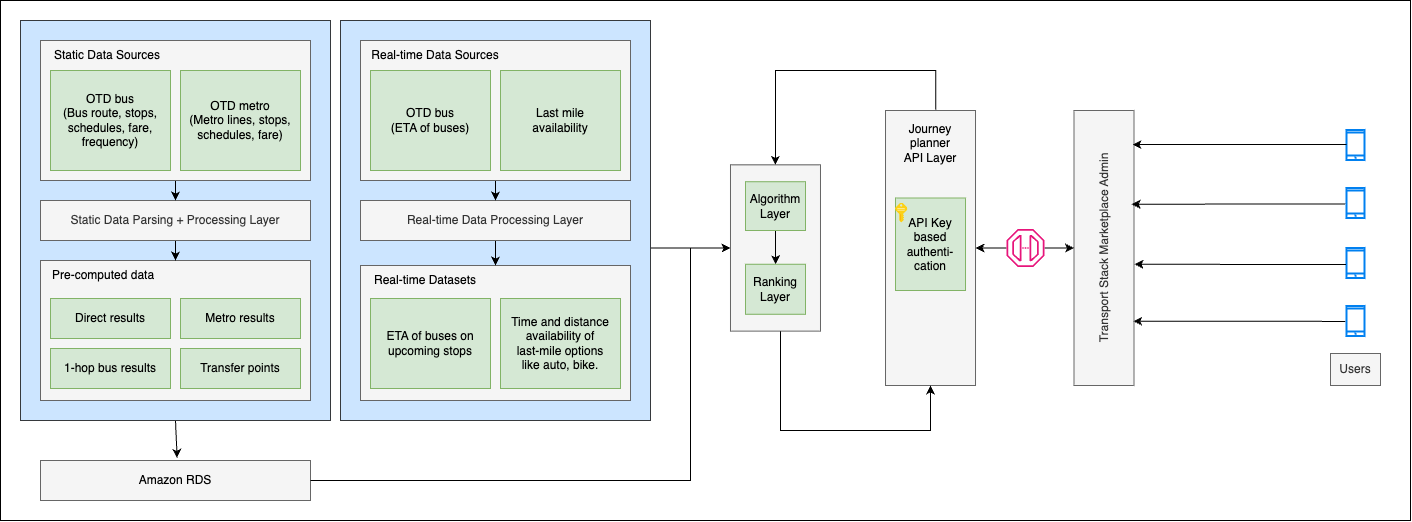
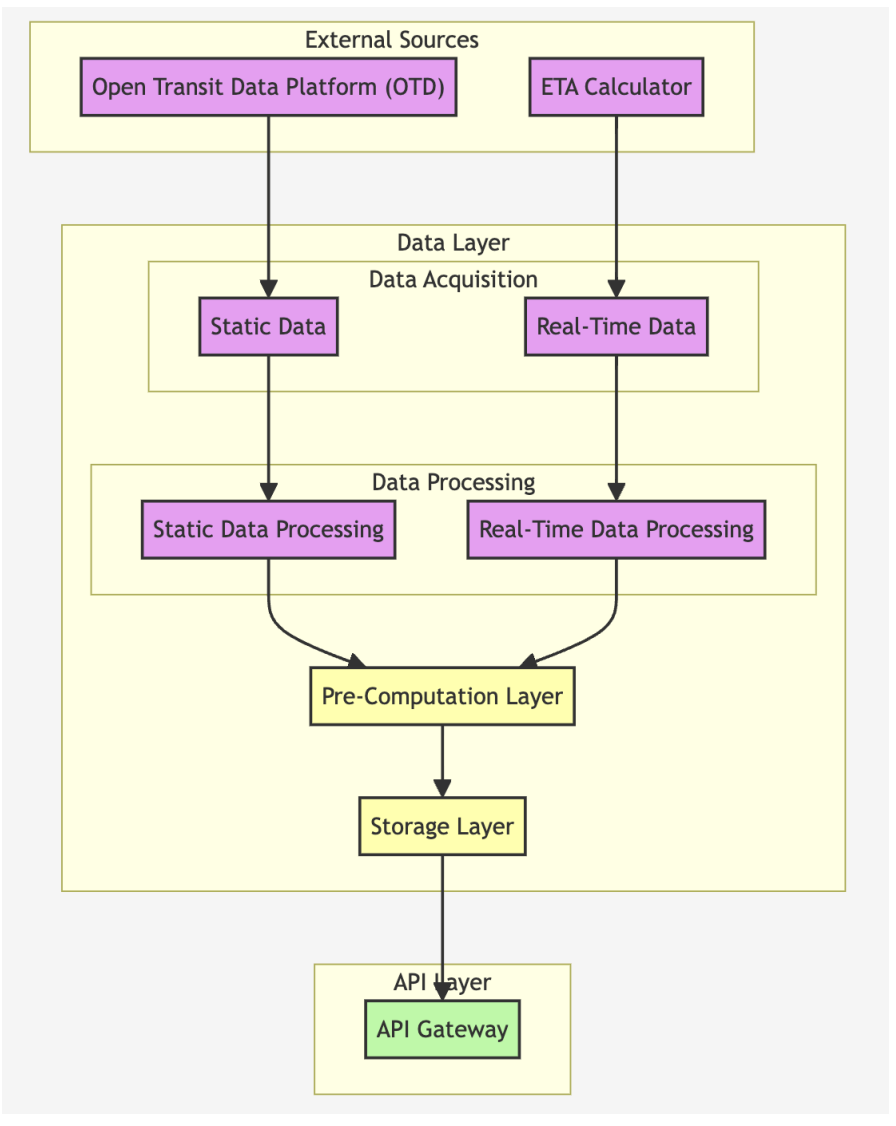
The service integrates multiple datasets, computes optimal journeys, and exposes results through scalable APIs.
Data Layer
- Static Data: Includes stops, routes, schedules, stop sequences, and fare information. Grouping of nearby stops (via "walk edges") is used to enable better multimodal connectivity.
- Real-Time Data: Live vehicle positions and ETAs, allowing dynamic updates for delay, disruption, and vehicle arrival information.
- Dynamic Data: Covers first/last mile mode availability (e.g., bike, auto, rideshare) and estimated pickup times.
Data Processing Layer
- Data Cleaning: Removes duplicate stops, clusters nearby stops, and generates logical walk edges.
- Graph Conversion: Transforms transit data into a graph model for algorithmic routing.
- Real-Time Integration: Merges live feeds with static schedules to compute timely and accurate trip suggestions.
- Filtering & Ranking: Applies business logic to prioritize routes by real-time reliability, convenience, and user preferences.
Pre-Computation Layer
- Pre-computes popular origin-destination pairs, journey times, transfer metadata, and fare details.
- Periodically refreshed when static data updates occur.
- Ensures lower latency and higher system throughput during peak hours.
Storage Layer
- Uses a relational database with tightly coupled schema aligned with the routing engine.
- Precomputed results are indexed for fast lookup and API delivery.
Journey Planner Algorithm
The system leverages advanced algorithms to provide optimal and user-friendly trip recommendations across modes.
Route Planning Highlights
- Determines the most efficient routes using a blend of static schedules and real-time data feeds.
- Enables seamless multimodal navigation across different transportation services.
- Minimizes user inconvenience by discouraging excessive transfers and long walking segments.
- Prioritizes routes that are direct, time-efficient, and reflect current traffic or service conditions.
Filtering and Ranking
- Filters routes based on:
- Schedule availability
- Transfer limits
- Fare constraints
- User-selected modes
- Ranks options by:
- Real-time availability
- Travel time
- Frequency
- Comfort and accessibility
Optimization Model
The journey planner employs an optimization model to deliver efficient, practical, and reliable travel options using a weighted cost function.
Cost Function Components
- Travel Time: Sum of segment times between stops.
- Waiting Time: Real-time vehicle arrival delays at origin points.
- Transfer Penalty:
- Higher penalty for walking to another stop.
- Lower penalty for same-stop transfers.
- Walk Edge Constraints: Routes with two consecutive walk segments are discarded.
Optimization Pipeline
- Input Mapping: Maps user's source and destination to nearest valid stops.
- Shortest Path Computation: Runs routing algorithm for each valid pair.
- Result Scoring: Applies filtering and ranking logic.
- User Presentation: Curated journey options are returned to the interface or API client.
Error Handling
| Scenario | Status | Message |
|---|---|---|
| Missing input | Failed | "parameter missing" |
| Invalid stop ID or mode type | Failed | "invalid parameter" |
| Coordinates outside service area | Failed | "no result found" |
| Incorrect time format | Failed | "invalid parameter" |
API Endpoints
- API Gateway: Handles request management, security, rate limiting, and analytics.
- Public APIs:
/api/get_stops?mode=<bus|metro|multi-modal>/api/<version>/get_multi_modal/?<args>
1. Get Stops
- Endpoint:
/api/get_stops?<args> - Method: GET
- Arguments:
mode:bus,metro, ormulti-modal
- Example:
/api/get_stops?mode=bus
2. Get Multi-Modal Journey
- Endpoint:
/api/<version>/get_multi_modal/?<args> - Method: GET
- Required Arguments:
src_type,src,dst_type,dest,mode
- Optional Arguments:
time,src_name,dst_name
- Example:
/api/v2/get_multi_modal/?src=[28.7041,77.1025]&src_type=place&dst=28.7041,77.1025&dst_type=place&mode=bus
Performance & Security Considerations
The platform is built to handle high-demand environments while ensuring robust protection of data and services.
Scalability
- Architect as cloud-native, enabling flexible and resilient infrastructure.
- Incorporate auto-scaling and low-latency caching to efficiently manage high volumes of traffic.
Security
- Ensure secure access through token-based authentication mechanisms.
- Encrypt all data in transit using industry-standard protocols (SSL/TLS).
- Ensure backend systems are isolated within private network zones and protected by firewalls.
Open Source Repository
The source code and API documentation for the Journey Planner are available on GitHub:
Journey Planner GitHub Repository